
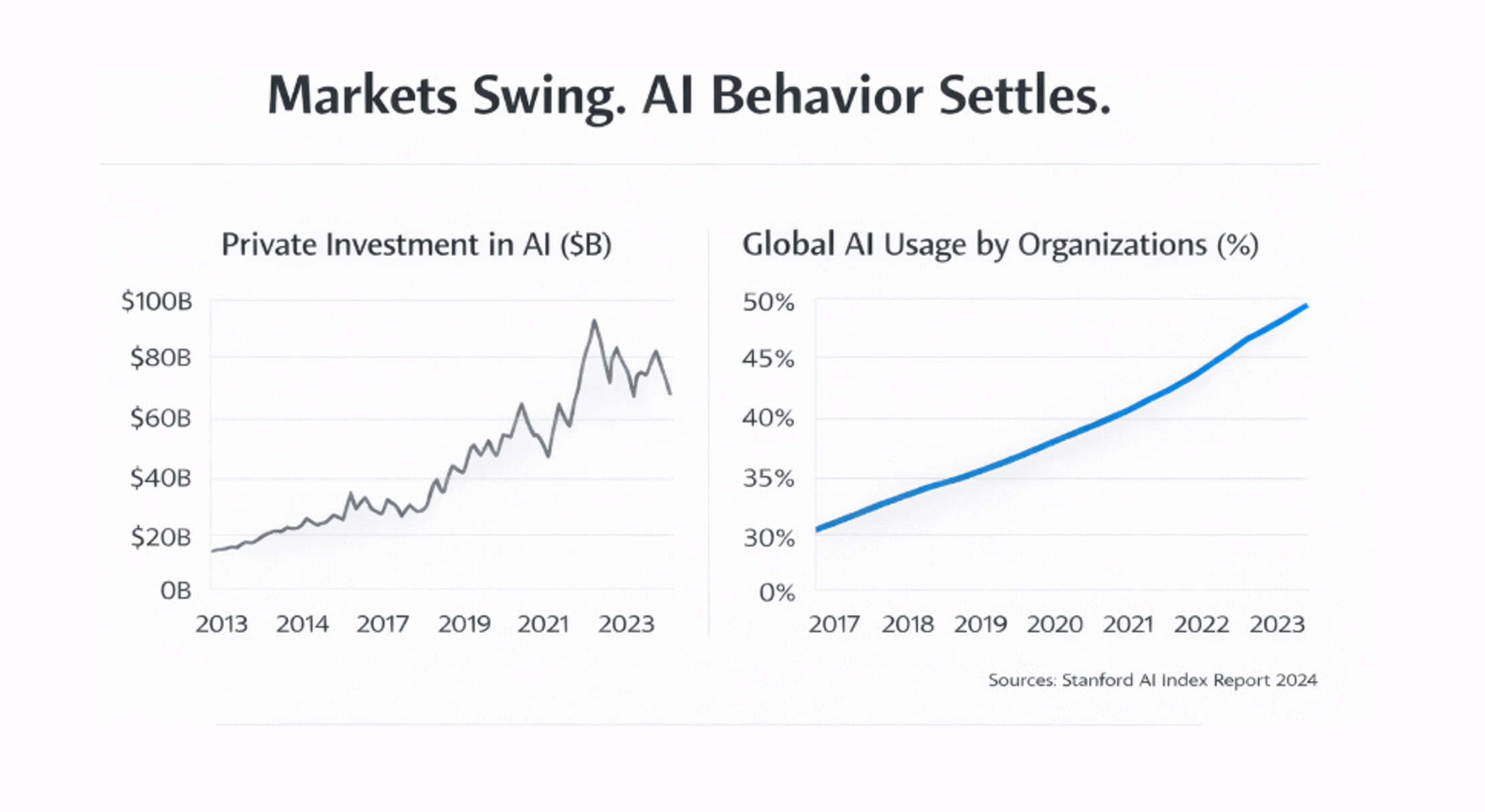
It’s pretty much commonplace now that every major technological shift attracts the same early accusation: “!t’s a bubble!” Artificial intelligence is no exception, now finding itself squarely in that familiar territory. Massive investments, soaring valuations, and aggressive corporate spending have led many to compare today’s AI moment to the obscurely remembered late-1990s dot-com boom. The implication is reassuring in its simplicity -- slow down, wait long enough, and eventually the hype will deflate.
But bubbles are built on hope.
AI is built on habit.
A bubble forms when belief runs ahead of behavior -- when capital chases what might happen rather than what is already happening. When expectations outrun usage, the air eventually comes out. Prices fall. Confidence breaks. That is the classic pattern.
But take note: what differentiates AI from this cookie cutter bubble is that the behavior came first.
Across industries, AI is no longer something people are trying. It is something they are using -- daily, habitually, and increasingly by default. Workflows have changed. Decision-making has changed. Expectations inside organizations have changed. These are not projections or promises. They are routines.
That distinction -- habit versus hope -- is the difference between a bubble and a bedrock.
“Bubbles inflate on expectation. Bedrock forms through habit.”
The dot-com bubble offers the clearest contrast. In the late 1990s, investors were right about what the internet would eventually become -- but wrong about timing. Capital surged ahead of infrastructure. Most households lacked broadband. E-commerce was immature. Daily usage was shallow. Companies were valued on projected traffic, imagined monetization, and first-mover narratives untethered from revenue.
When expectations collided with reality…tick tock BOOM, the bubble burst. Not because the internet failed, but because the foundation was not yet strong enough to support the weight placed upon it. The internet survived, hardened, and eventually became infrastructure—but only after years of collapse and consolidation.
History offers another useful parallel that sharpens the distinction between bubbles and bedrock. Way back in the mid-19th century, railroads experienced one of the earliest technology manias. Capital flooded in ahead of proven demand, pricing models, and operational discipline. Speculation ran rabid. The crash that followed wiped out investors and companies alike. Yet the railroads themselves did not disappear. They became permanent national infrastructure. The bubble corrected valuation, not relevance. AI increasingly resembles railroads -- not because it is overhyped, but because it is infrastructural. Even when capital misprices the future, technologies that embed themselves into daily economic behavior do not vanish when markets sober up.
Artificial intelligence enters the economy from the opposite direction.
AI is not waiting to be adopted. It already has been. It’s embedded into how work gets done across sectors…often invisibly. Software is written and debugged with AI assistance. Supply chains are optimized by machine-learning models. Fraud detection, marketing, customer service, research, and analysis increasingly rely on AI as a baseline capability. These are not pilots or experiments. They are habits.
And habits, once formed at scale, do not easily reverse.
This leads to the most misunderstood point in the “AI bubble” debate: even failure will not stop AI adoption. If today’s technology giants fail to justify the scale of their AI investments, AI usage will not disappear with them. Businesses have already reorganized workflows around AI-enabled productivity. Competitive pressure now enforces adoption rather than encourages it. Employees increasingly expect AI augmentation as standard, not optional.
If one vendor falters, another replaces it. If one model proves inefficient, a better one emerges. The infrastructure may change, but the behavior remains.
This is not speculative capital chasing a dream.
This is operational dependency setting in.
That distinction also explains why market corrections -- if and when they occur -- should not be confused with collapse. Capital cycles and usage cycles are not the same thing. Markets swing. Technologies that become foundational do not simply vanish when valuations reset. No company returned to typewriters after the personal computer market corrected. No organization abandoned email after the dot-com crash.
Once a technology becomes part of the baseline, it stops being optional.
The deeper shift underway is structural, not financial. The internet changed where information lived. Artificial intelligence changes how work is performed -- how decisions are made, how knowledge is applied, and how cognitive labor scales. AI reduces cognitive load, compresses time to insight, lowers labor costs, and erodes barriers to expertise. Those efficiencies compound. And compounding efficiencies do not disappear because investor sentiment cools.
What we are witnessing now is not a bubble stretching toward collapse. It is a technology hardening into place. The hype will fade. Weak players will fall away. Strong platforms will integrate quietly and thoroughly -- just as the internet eventually did once it stopped being novel and started being necessary.
When critics warn of an AI bubble, they are often reacting to excess capital, aggressive valuations, and speculative narratives that assume flawless execution and instant returns. Those concerns may justify caution in markets, but they describe a pricing debate—not a usage debate.
A bubble is belief without dependency. AI has already crossed that line.
The dot-com era was a bet on what might happen. AI is a reflection of what is already happening.
You can debate valuations.
You can debate winners.
You cannot debate adoption.
This is not a bubble floating above the economy, waiting to burst. AI is bedrock settling beneath it—quietly, heavily, and permanently.